
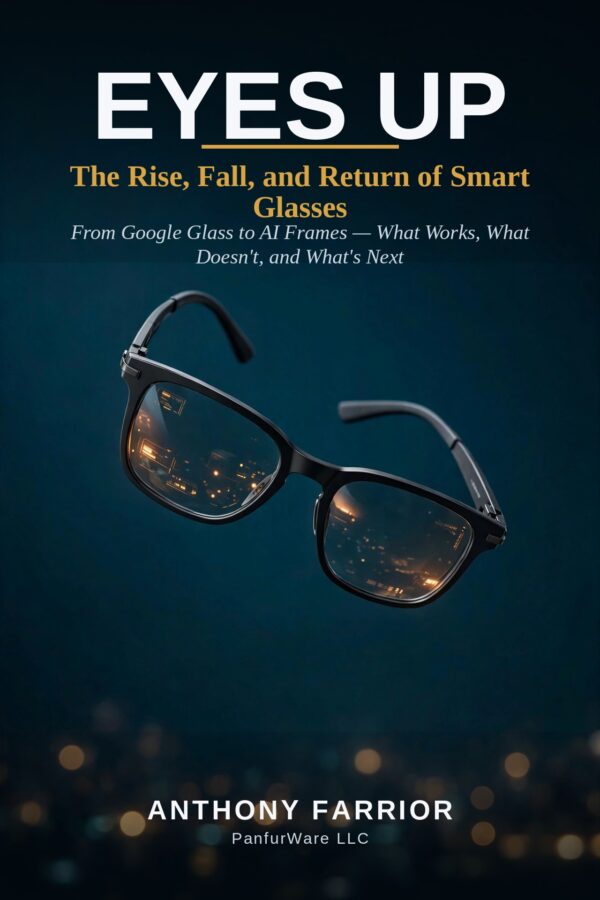
You keep seeing the ads: glasses that answer questions, translate signs, and record what you see. Then you remember Google Glass — the hype, the backlash, the shutdown — and you cannot tell if this new wave is real progress or the same promise in a better frame. Every review covers one pair. Nobody tells the whole story straight.
That is the problem for anyone who creates, publishes, or just wants to buy with open eyes: the facts are scattered across a decade of launches, pivots, and quiet failures, and the headline version leaves out the parts that matter — privacy, cost, and what the glasses actually do well.
Eyes Up: The Rise, Fall, and Return of Smart Glasses puts that whole story in one place — where smart glasses came from, why they fell, how they came back, and what to make of what is next — so you can talk about them, write about them, or choose a pair knowing the full record.
Smart glasses failed so publicly that they gave us a brand-new insult — then came back and sold more than seven million pairs in a single year. Eyes Up is the full, straight story: what smart glasses are, where they came from, how they work, what they are genuinely good at, what should make you think twice, and where they are going next — every date, price, and spec drawn from the public record, in plain language, with the math in the open.
Instant download: after checkout you get a download link on the confirmation screen, by email, and in your INKIQ.SHOP account. Formats included: PDF and EPUB. Read on any device — phone, tablet, e-reader, or computer.
Inside: the three kinds of smart glasses (audio, camera/AI, and display) and why confusing them costs buyers money; the deep history — Baum’s 1901 fiction, Sutherland’s 1968 Sword of Damocles, Steve Mann’s EyeTap, and the coining of “augmented reality”; the complete Google Glass saga — the $1,500 Explorer Edition, the privacy backlash, the enterprise pivot, and the 2023 shutdown; the quiet decade of Snap Spectacles, Bose Frames, and Amazon Echo Frames; how fashion fixed it — Ray-Ban Stories (2021), Ray-Ban Meta (2023), Gen 2 and Oakley Meta (2025), and the seven-million-pair year; how the technology actually works — cameras, microphone arrays, open-ear audio, waveguide displays, on-device vs. phone vs. cloud AI, and the EMG Neural Band; the honest pluses — hands-free capture, accessibility for blind and deaf users, translation, navigation, and real workplace wins; the honest minuses — bystander consent and recording law, data harvesting, battery life, true cost with prescription lenses, distraction, AI error, and platform lock-in; the return of the display — Meta Ray-Ban Display ($799, 2025), Snap’s $2,195 Specs (2026), and Google’s Android XR Intelligent Eyewear with Warby Parker and Gentle Monster (December 2026); a practical buying guide with a pre-purchase checklist; IDC market forecasts to 2030; and Anthony Farrior’s own verdict — what he would buy, what he would skip, and why. 42 pages.
By Anthony Farrior · PanfurWare LLC.
Digital download — please read our Download Terms before purchase.







Reviews
There are no reviews yet.