
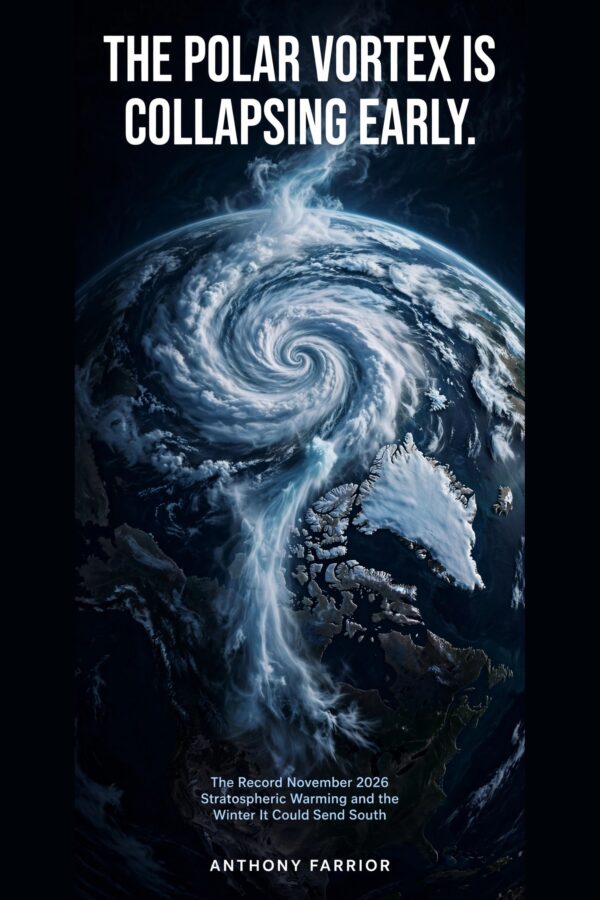
The headline lands in November: the polar vortex is collapsing, winter is coming early, records may fall. One site promises a historic freeze. Another says it might mean nothing at all. You close the tab knowing less than when you opened it — and the cold, whatever it does, is still coming.
That is the problem with weather news at this scale: the real story lives thirty kilometers up, in a stratosphere almost no explainer explains, and the surface forecast depends on signals still weeks from settling. The fragments never add up to an answer you can act on.
The Polar Vortex Is Collapsing Early is that answer in one place — what the vortex is, what actually happened in November 2026, and what a winter like this could send south, told straight in plain language.
Thirty kilometers above the North Pole, in the dark of the polar night, sits the machine that runs winter: the polar vortex, a ring of wind holding the coldest air on Earth in place. In November 2026 that machine began to fail — earlier than it ever has. The specialist forecasters who track the stratosphere watched the winds at 10 hPa collapse toward a full reversal and the vortex tear into two separate cores. If the reversal verifies, it will stand as the earliest sudden stratospheric warming on record, by at least three weeks. Events like this are supposed to be January news. This one arrived before Thanksgiving.
Instant download: after checkout you get a download link on the confirmation screen, by email, and in your INKIQ.SHOP account. Formats included: PDF (43 pages) and EPUB. Read on any device — phone, tablet, e-reader, or computer.
The Polar Vortex Is Collapsing Early answers, in plain language, the questions the headlines skip:
What is the polar vortex, really? The two stacked vortices, why the ring of wind exists, what strong and weak actually mean, and how the stratosphere talks to the weather at your door — on a delay of one to six weeks.
What happened in November 2026? What the ECMWF and GFS models showed, what the November 13 model agreement settled and what it didn’t, the split into two cores, the earliest-on-record stakes, and the possibility of a second, stronger disruption in mid-winter — observed facts and forecasts labeled as which is which, throughout.
What could this winter send south? The patterns forecasters watch after a collapse like this — the Arctic Oscillation going negative, blocking over Greenland, cold for the eastern United States and parts of Europe — the Thanksgiving window, the December–January season, and what would make the whole signal fizzle.
What is fighting it? A strong El Niño is running at the same time (NOAA), pulling the season the other way. Why forecasters call this winter hard to read, and why dueling signals mean swings, not averages.
What does the record say? Case files: January 2014, when “polar vortex” went mainstream; February 2018 and Europe’s Beast from the East; January 2019, when the Midwest took wind chills below minus fifty; and February 2021 in Texas — with the scientific debate about that winter’s exact chain of causes stated honestly, not smoothed over.
What do you do about it? The effects beyond the thermometer — grids, travel, health, farms, pipes — and a full preparation chapter: home winterization, pipe protection, outage kits, generator safety (never indoors), vehicle kits, and checking on the people the cold hurts first.
Plus the open scientific question — whether a warming Arctic is breaking the vortex more often — presented as what it is: unsettled, with both research camps stated fairly. No hype, no promised apocalypse, no invented numbers.
By Anthony Farrior · PanfurWare LLC.
Digital download — please read our Download Terms before purchase.







Reviews
There are no reviews yet.