
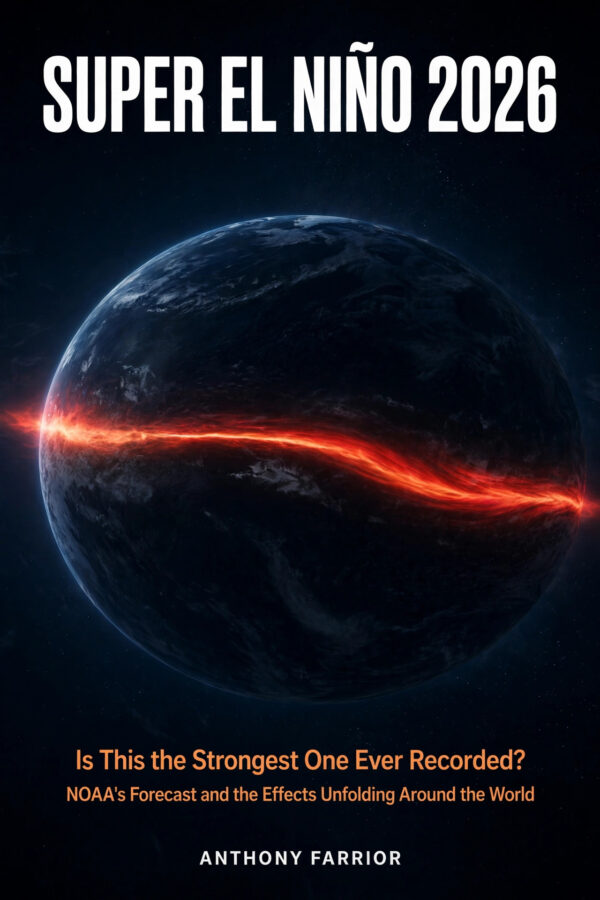
Every few years the same phrase returns: Super El Niño. This time the bulletins say the numbers may pass every event on record — and the coverage splits between record heat, floods, drought, and grocery prices, with no one piece explaining how one warm patch of Pacific water connects to any of it.
So you are left with a headline you half-understand: strong, very strong, historic — measured how, forecast by whom, and likely to do what, where you live? The probabilities get quoted without the meaning, and the tendencies get dressed up as promises.
Super El Niño 2026 tells the story whole — what El Niño is, how NOAA measures it, what the November 2026 forecast actually says, and what past super events did — every number from the official record, in plain language.
On November 12, 2026, NOAA’s Climate Prediction Center issued the bulletin this book is built on. El Niño is present and strengthening. The latest three-month reading — the Relative Oceanic Niño Index for August–October 2026 — stands at +2.0 degrees Celsius, already in very strong territory. A strong-to-very strong event is likely through January–March 2027, with a greater than 79 percent chance. And the odds of a historic event — one exceeding every El Niño in the record books dating back to 1950 — are about 60 percent for the peak windows of this winter.
Instant download: after checkout you get a download link on the confirmation screen, by email, and in your INKIQ.SHOP account. Formats included: PDF (41 pages) and EPUB. Read on any device — phone, tablet, e-reader, or computer.
Super El Niño 2026 walks the whole story in plain language:
What El Niño is — the Pacific engine: trade winds, warm water, and the atmosphere answering back, and why one warm patch of ocean moves weather on every continent.
Where the name came from — the fishermen of Peru who named the Christmas current, and the century of science that connected their warm water to the whole planet’s sky.
How NOAA measures it — the Niño regions, the ONI and RONI indexes, what +2.0 and +2.5 actually mean, and how to read a forecast probability without being fooled by a headline.
The 2026 event so far — how it built from the east, with the water off Peru at +2.1 degrees while the central Pacific was still at +0.7, and what the November 12 discussion says in full.
The forecast — the peak this winter, the expected fade in spring 2027, and what the December 10, 2026 update will settle.
The Super El Niños of the past — 1982–83, 1997–98, 2015–16, and the record heat of 2023–24: what “strongest ever” would actually mean.
The effects — America’s wet South and warm North (plus this winter’s polar vortex complication), South America’s floods and failing fisheries, Australia and Indonesia’s drought and fire, East Africa’s floods, the world’s bleaching reefs, and the road from one warm ocean to your grocery bill, your energy bill, and your insurance renewal.
Getting ready — practical preparation by zone, and how to follow NOAA’s monthly updates straight from the source.
Every number in this book comes from the official record, quoted with its probability attached. Tendencies are called tendencies. Forecasts are never dressed up as facts.
By Anthony Farrior · PanfurWare LLC.
Digital download — please read our Download Terms before purchase.







Reviews
There are no reviews yet.