
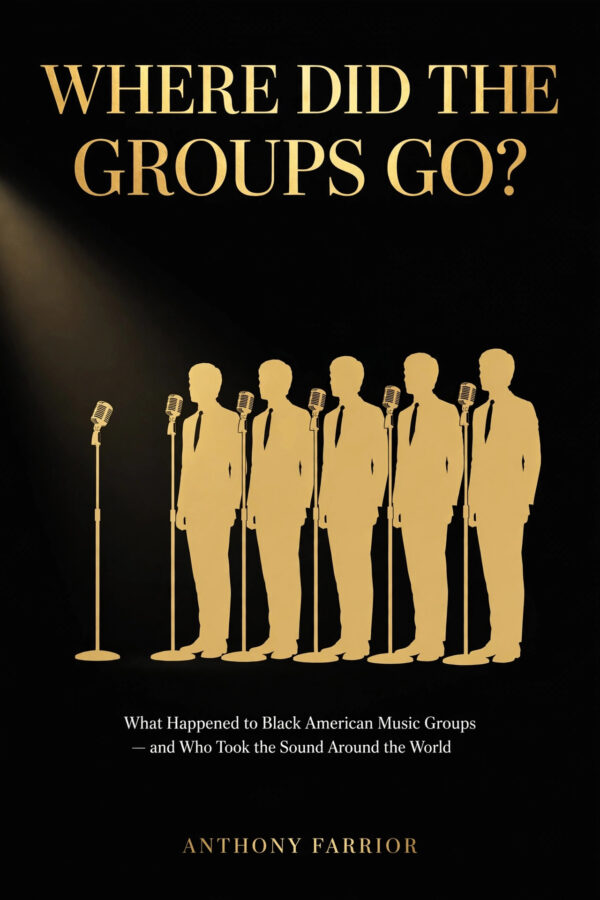
Put on an old playlist and count: group after group — harmonies, choreography, five voices moving as one. Then look at today’s charts and ask the question out loud: where did they all go? The solo stars never stopped coming. The groups just stopped — and nobody ever explained why.
It is not nostalgia playing tricks. For most of the twentieth century the group was the format in Black American music, and within about one generation it vanished from the American industry — while the same blueprint started producing the biggest acts on Earth somewhere else entirely.
Where Did the Groups Go? answers that question with the record in the open — what happened, who was last, and who took the sound around the world — the story nobody had told straight, in one place.
For most of the twentieth century, the group was not one format among many in Black American music. It was the format. The Temptations. The Supremes. The Jackson 5. Earth, Wind & Fire. En Vogue. TLC. Boyz II Men — four young men from a Philadelphia public school who broke chart records that had stood since Elvis Presley, three separate times.
Instant download: after checkout you get a download link on the confirmation screen, by email, and in your INKIQ.SHOP account. Formats included: PDF (41 pages) and EPUB. Read on any device — phone, tablet, e-reader, or computer.
Then, in about one generation, it stopped. The solo stars kept coming. The groups did not. And the format did not die — it moved. Where Did the Groups Go? answers three questions with the record in the open:
What happened? The documented causes: group economics that split one advance four or five ways (TLC filed for bankruptcy in 1995, at the height of their success, and said so at the Grammys), the end of label artist development, radio consolidation after 1996, the album-to-single-to-streaming shift, and the solo-breakout incentive built into the contracts themselves.
Who was last? The author’s verdict, labeled as a verdict and argued from the receipts: Boyz II Men, the most commercially successful R&B group of all time, still performing today as a trio — and Destiny’s Child, whose wind-down in the mid-2000s is the exact hinge where the industry’s center moved from groups to solo stars. Plus the last new groups to top the charts at all: B2K and Danity Kane.
Who took over? K-pop — openly. SM Entertainment founder Lee Soo-man: “We made K-pop based on Black music.” HYBE founder Bang Si-hyuk: “Black music is the base.” The trainee system descends from Motown’s finishing school, and BTS became the best-selling act on Earth two years running with it. Afrobeats took the sound global the other way — through solo stars. The blueprint is Black American. The industry that still builds groups with it is in Seoul.
Written in plain language with the numbers in the open — the 13, 14, and 16 weeks at number one, the 50 cumulative weeks, the bankruptcy at the top — and a listening-list appendix that walks the whole lineage, from the Motown machine to BTS and BLACKPINK. A music-history book that gives the architects their credit, including the ones honest enough to say where the blueprint came from.
By Anthony Farrior · PanfurWare LLC.
Digital download — please read our Download Terms before purchase.







Reviews
There are no reviews yet.